
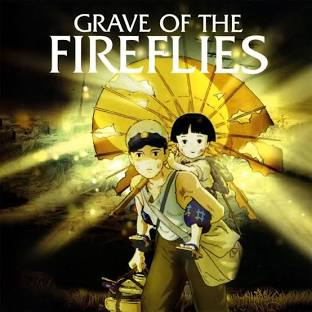
Grave of the Fireflies[a] is a 1988 Japanese animated historical war drama film written and directed by Isao Takahata, and produced by Studio Ghibli. It is based on the 1967 semi-autobiographical short story of the same name by Akiyuki Nosaka. Set in the city of Kobe, Japan, it tells the story of siblings and war orphans Seita and Setsuko, and their desperate struggle to survive during the final months of the Pacific War.
The film stars Tsutomu Tatsumi, Ayano Shiraishi [ja], Yoshiko Shinohara [ja] and Akemi Yamaguchi [ja]. The film was theatrically released on April 16, 1988.[4] Universally acclaimed, Grave of the Fireflies has been ranked as one of the greatest war films of all time and is recognized as a major work of Japanese animation.[5][6] It has gained particular praise for its emotional impact.[7][8]
Plot
[edit]
In March 1945, American bombers destroy most of Kobe during the waning days of the Pacific War. Children of an Imperial Japanese Navy captain, Seita and his sister Setsuko, survive, but their mother dies. Seita conceals their mother’s death from Setsuko. The siblings move in with a distant aunt, and Seita retrieves supplies he buried before the bombing and gives everything to his aunt, save for a tin of Sakuma drops, which he gives to Setsuko. The aunt convinces Seita to sell his mother’s silk kimonos for rice, which devastates Setsuko.
As rations shrink, the aunt becomes resentful of the children as Seita does nothing to earn the food she prepares for them. At her suggestion, Seita withdraws some money from his mother’s bank account to buy a charcoal stove and other supplies. Following an air raid, the siblings move into an abandoned bomb shelter. They capture fireflies from the marshes and release them into the refuge for light. The following morning the fireflies have died. Setsuko buries them and reveals their aunt told her their mother died, then tearfully asks why the fireflies had to die so soon.
Things become grim when they run out of rice and a friendly farmer insists that Seita swallow his pride and return to their aunt as they can’t survive alone. Seita steals crops from farms and breaks into people’s homes during air raids. A farmer catches and beats him, but a police officer sympathizes with Seita as he is only stealing to feed Setsuko.
Setsuko falls ill, and a doctor explains she is suffering malnutrition. Seita withdraws the last of the money from their mother’s bank account. He is distraught to learn that Japan has surrendered and that his father is most likely dead, as most of Japan’s naval fleet have been sunk. Seita returns to Setsuko with food and finds her hallucinating. She dies as Seita finishes preparing the food. Seita cremates Setsuko’s body and her doll in a straw casket. He carries her ashes in the candy tin along with his father’s photograph.
Seita dies of starvation a few weeks later at a Sannomiya train station surrounded by other malnourished people. A janitor, tasked with removing the bodies before the Americans’ arrival, sorts through Seita’s possessions. He finds the candy tin and throws it into a field. Setsuko’s ashes spread out, and her spirit springs from the container and is joined by Seita’s spirit and a cloud of fireflies. The two board a ghostly train and, throughout the journey, look back at the events leading to Seita’s death as silent, passive observers.[b] Their spirits arrive at their destination: a hilltop bench overlooking present-day Kobe, surrounded by fireflies, healthy and content.
